
The global artificial intelligence (AI) market continues its rapid ascent. According to recent forecasts, the AI industry is expected to grow from roughly US$235 billion in 2024 to more than US$631 billion by 2028.
Against this backdrop, a select group of startups are positioning themselves to become the next wave of unicorns companies valued at US$1 billion or more. In this article, I identify five rising AI startups that, based on funding, market positioning and technological innovation, deserve close attention in 2026. I also examine key trends driving this ecosystem, and how entrepreneurs and investors should navigate this shifting landscape.
Why 2026 is a Pivotal Year
Several dynamics converge to make 2026 a critical “inflection year” for AI startups:
- Mature infrastructure: As cloud costs decline and AI tooling becomes more accessible, startups can scale faster and with lower upfront investment.
- Enterprise adoption: Companies are shifting from experimentation to serious deployment of generative AI and automation creating large addressable markets.
- Capital and competition intensify: Funding rounds are larger and more selective; only startups with defensible moats will survive. Indeed, one analyst argues that “99 % of AI startups will be dead by 2026” due to lack of differentiation.
- Geographic and sectoral expansion: AI innovation isn’t only in Silicon Valley; Europe, Canada and Asia are producing contenders.
Given that backdrop, let’s profile five AI startups to watch heading into 2026.
Mistral AI (Paris, France)

Why it matters: Founded in April 2023 by ex-Google DeepMind and Meta researchers, Mistral AI is positioning itself as Europe’s answer to U.S. generative-AI leaders.
In September 2025 it announced a €1.7 billion funding round that values the company at about €11.7 billion (≈ US$13–14 billion), with Dutch semiconductor giant ASML taking an 11 % stake.
Focus and differentiation: Mistral develops both open-weight and proprietary large-language models (LLMs) geared for enterprise deployment and on-premises use. Its emphasis on model efficiency (e.g., pricing its API at US$0.40 per million input tokens) promises lower cost for customers.
Outlook for 2026: With a strong valuation and European backing, Mistral is poised to scale internationally. Its competition with U.S. players (e.g., OpenAI) will be intense, but its regional advantage and open-model strategy give it a compelling position.
Key risk: The company must demonstrate high-growth m
Cohere (Toronto, Canada)

Why it matters: Cohere is an enterprise-focused generative-AI startup building large language models and solutions for businesses. In August 2025 it raised US$500 million at a valuation of US$6.8 billion. Recent extensions suggest the valuation may reach US$7 billion.
Focus and differentiation: Unlike consumer-chat tools, Cohere targets enterprise workflows: text analytics, document automation, and “agents” that run within companies’ data. (See their website quote: “Train our models on your proprietary data … accelerate adoption of generative AI globally.”)
Outlook for 2026: With enterprise demand accelerating, Cohere is well-positioned. If it expands its global footprint and builds strong recurring revenue streams, it could be among the next unicorn exits or major platform providers.
Key risk: Enterprise AI is crowded. Cohere must maintain product differentiation and strong customer retention to justify its valuation.
Replit (San Francisco, USA)
Why it matters: Replit isn’t a pure LLM startup; rather it offers an AI-powered coding platform (“vibe coding”) that’s rapidly scaling. According to a Business Insider leak, it expects to hit US$1 billion in revenue by end of 2026 up from around US$150 million in annualised revenue as of September 2025.
Focus and differentiation: By enabling developers to build applications with AI assistance and moving away from legacy “no-code/low-code” tools, Replit is tapping a high-growth niche: developer productivity enhanced by AI. The company also touts enterprise margins up to ~80 %.
Outlook for 2026: If Replit delivers its revenue target and retains high-margin enterprise deals, it could become a major platform in the “developer AI” market. This distinguishes it from traditional LLM-service providers, giving it a unique niche.
Key risk: Developer tooling is competitive. Maintaining growth, expanding beyond base users, and fending off larger platforms will be challenging.
Lila Sciences (Cambridge, Massachusetts, USA)
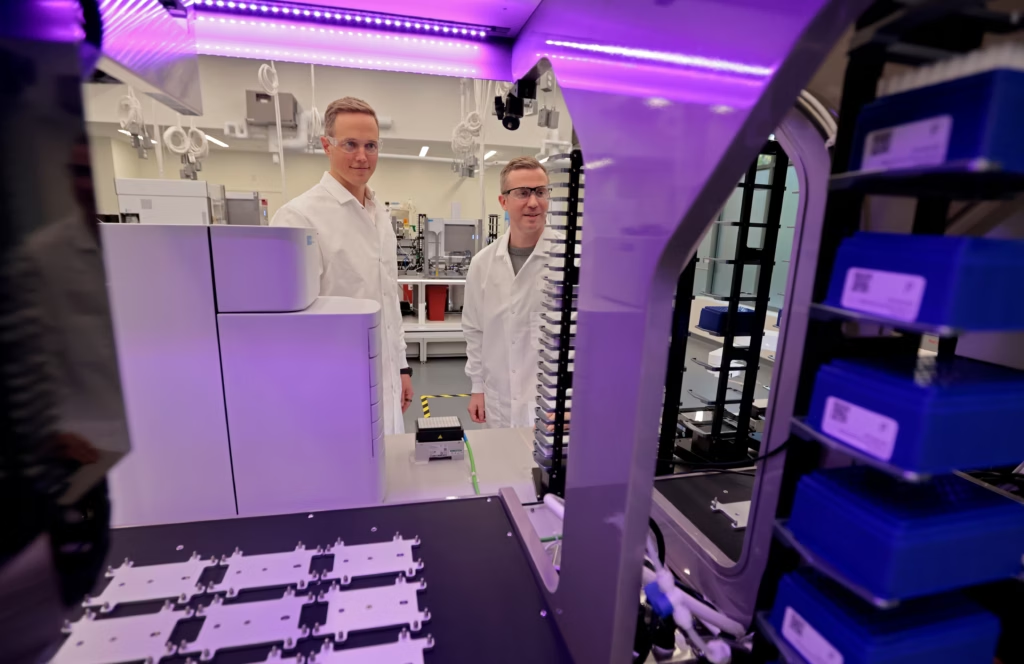
Why it matters: Lila Sciences is applying generative-AI techniques to scientific discovery: combining AI models with robot-powered labs to accelerate experiments and innovation. In October 2025 it raised US$115 million (Series A extension) with a valuation over US$1.3 billion.
Focus and differentiation: By targeting life sciences, materials and energy sectors with “AI science factories,” Lila addresses a less-crowded and high-value space: scientific R&D that typically involves huge time and cost. This is a strong strategic niche.
Outlook for 2026: If Lila can secure enterprise partnerships and demonstrate tangible outcomes (e.g., compounds discovered, materials optimised), it could evolve from startup to platform, opening a pathway to unicorn status.
Key risk: Scientific discovery is longer horizon and riskier than software; translating model capability into commercial revenue will take time.
Thinking Machines Lab (San Francisco, USA)

Why it matters: Co-founded by former OpenAI researchers including CEO Mira Murati, Thinking Machines raised a record-breaking US$2 billion seed round in mid-2025, valuing it at ~US$12 billion.
Focus and differentiation: The firm is building advanced multimodal AI (text, vision, code, reasoning) aiming for superhuman-level capabilities. Given the founding team and funding, it is positioned in the “frontier AI” tier rather than incremental applications.
Outlook for 2026: If it delivers pioneering research or platform launches, it could shape the next phase of generative-AI evolution, and emerge as one of the top-tier unicorns.
Key risk: High-risk, high-reward. Frontier AI development has unpredictable horizon; regulatory and compute-cost risks are meaningful.
Key Trends & What to Watch
🔍 Sectoral expansion
AI is no longer limited to chatbots and creative tools. We see significant momentum in:
- Enterprise automation (e.g., document processing, agents)
- Developer tooling (e.g., Replit)
- Scientific discovery and materials/energy (e.g., Lila)
- Frontier architectures / reasoning agents (e.g., Thinking Machines)
- Regional shifts (Europe’s Mistral)
📊 Funding and valuation data
Record financing rounds signal investor urgency. For example, Mistral’s €1.7 billion Series C marks the largest AI funding round in Europe. Meanwhile, enterprise AI startup Cohere’s US$6.8 billion valuation reflects the premium being paid for scalable business models.
⚠️ Market caution
Despite the optimism, not every AI startup will make it. As one commentator put it, most startups lack “defensible technology” and risk being commoditised. This makes execution, moat-creation, and monetisation key criteria.
🌍 Global perspective
While U.S. remains dominant, Canada (Cohere), Europe (Mistral), and others are rising. Global enterprise demand, regulatory diversity and compute infrastructure shifts mean geopolitics will play a larger role in AI startup success.
Actionable Takeaways
- For entrepreneurs: Focus on business-model clarity, recurring revenue, strong differentiation (beyond “we use AI”).
- For investors: Prioritise startups that target large addressable markets, have defensible moats (data, compute, domain expertise) and leadership teams with scale experience.
- For corporate executives: Monitor emerging AI platforms (Cohere, Mistral, Replit) for partnerships or ecosystem-plays.
- For professionals in the Gulf region (Qatar, Middle East): With the region’s push into AI and tech, particularly around infrastructure and services, aligning early with global-tier AI startups may present localisation and deployment opportunities.
Conclusion
2026 promises to be a landmark year for AI startups. The five companies profiled Mistral AI, Cohere, Replit, Lila Sciences and Thinking Machines Lab illustrate the range of opportunities: from enterprise generative AI and developer-platform disruption to frontier research and science automation.
For them to reach unicorn status or beyond, they must show strong execution, monetisation and global expansion. The broader lesson: AI isn’t just about hype anymore it’s about scaling business, capturing enterprise value, and building lasting capabilities.
Watch closely, invest wisely, and engage early these could be the next legacy platforms of the AI era.