
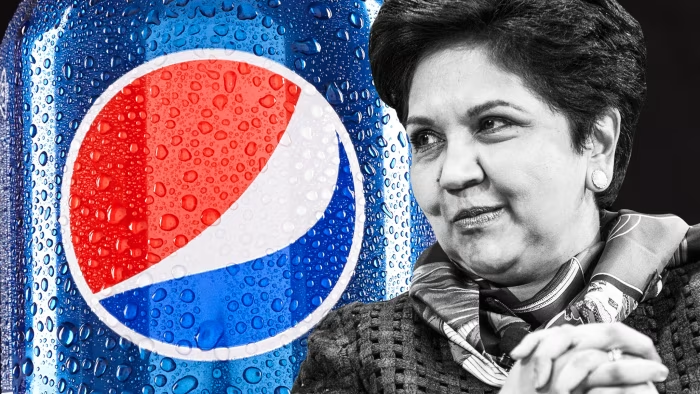
In boardrooms still shaped by legacy power structures, negotiation is often portrayed as a contest. Win-lose. Muscle versus muscle. Yet some of the most consequential deals of the past two decades were not won by outmaneuvering rivals, but by reframing the entire conversation. This article examines how one global executive negotiated without playing the game and, in doing so, rewrote the rules for leadership negotiation.
The subject is Indra Nooyi, the former CEO of PepsiCo. Her approach offers a masterclass for founders, executives, and emerging leaders navigating high-stakes decisions without resorting to dominance or theatrics. At a time when leadership credibility is increasingly tied to trust and long-term value, her story is more relevant than ever.
Negotiation Is Not a Game, It Is a System
Traditional negotiation theory often borrows metaphors from sports or war. There are winners and losers, leverage and concessions. Nooyi rejected this framing early in her career. She treated negotiation as a system design problem rather than a competitive event.
During her rise at PepsiCo in the late 1990s and early 2000s, the company faced mounting pressure to divest its restaurant brands and refocus on beverages and snacks. Internally, this sparked resistance from senior leaders who feared short-term revenue loss. According to Harvard Business Review interviews from that period, Nooyi did not force consensus. Instead, she mapped incentives across stakeholders and reframed the decision around shared long-term value creation.
One internal data point proved decisive. Financial models showed that separating restaurants would unlock billions in shareholder value within three years. By centering the conversation on collective outcomes rather than personal positions, she changed the negotiation terrain entirely.
She Built Moral Authority Before Structural Power
Before becoming CEO in 2006, Nooyi spent years accumulating what organizational psychologists call moral authority. This is influence derived not from title, but from perceived integrity, competence, and empathy.
Colleagues often recall that she listened more than she spoke in executive meetings. This was not passivity. It was intelligence gathering. By the time negotiations began, she understood not only the numbers, but the fears and ambitions driving each counterpart.
A McKinsey study from 2021 found that leaders with high moral authority are 3.5 times more likely to achieve durable agreement outcomes than those relying primarily on hierarchical power. Nooyi intuitively practiced this long before it became quantified.
Her negotiation strength came from credibility. When she made an ask, it was trusted to be principled, not tactical.
Reframing Conflict Into Shared Stewardship
One of Nooyi’s most cited strategic moves was the launch of PepsiCo’s “Performance with Purpose” agenda. On the surface, this was a sustainability and health initiative. In practice, it was a negotiation masterstroke.
She faced pressure from activists, regulators, and investors concerned about obesity, environmental impact, and long-term brand relevance. Rather than negotiate separately with each group, she reframed the conflict into a shared stewardship challenge. The question became not how much PepsiCo should concede, but how all parties could align around sustainable growth.
This reframing unlocked unexpected allies. Long-term institutional investors supported the strategy because it reduced regulatory risk. Governments engaged more collaboratively. Internally, it gave managers a unifying narrative.
Between 2006 and 2018, PepsiCo’s revenue grew from approximately $35 billion to over $63 billion, according to company annual reports. Negotiation without playing the game did not weaken performance. It strengthened it.
She Used Empathy as a Strategic Asset
Empathy is often misunderstood as softness. In negotiation, it is a precision tool. Nooyi famously wrote letters to the parents of senior executives, thanking them for raising leaders who contributed to the company. This gesture was not symbolic alone. It built loyalty that later mattered in moments of tension.
In negotiations with the board during the 2008 financial crisis, empathy allowed her to address unspoken anxieties. While many CEOs focused narrowly on cost-cutting, she articulated how decisions would affect employees, communities, and the company’s long-term license to operate.
According to a 2020 study published in the Journal of Applied Psychology, negotiators who demonstrate cognitive empathy achieve higher joint gains without sacrificing individual outcomes. Nooyi’s approach exemplified this finding years earlier.
Influence Without Performing Masculinity
A critical aspect of Nooyi’s negotiation style was what she did not do. She did not mimic traditionally masculine behaviors to signal strength. No chest-thumping. No brinkmanship.
Instead, she expanded the definition of authority. Calm preparation replaced aggressive posturing. Narrative replaced threat. This mattered deeply in environments where women leaders are often penalized for assertiveness while being dismissed for accommodation.
By refusing to play the expected game, she made it obsolete. Her success challenged the false binary between warmth and competence, showing that strategic persuasion can be both human and hard-nosed.
Global Perspective as Negotiation Leverage
Born and educated in India before building her career in the United States, Nooyi brought a global lens to every major negotiation. This perspective proved invaluable as PepsiCo expanded in emerging markets.
In negotiations with governments in Asia, Africa, and Latin America, she emphasized local partnership rather than extractive growth. This approach reduced friction and accelerated market entry. By 2015, more than 50 percent of PepsiCo’s revenue came from outside North America.
Global leaders increasingly operate across cultures where adversarial negotiation norms backfire. Nooyi’s style offers a template for influence that travels well across borders.
Conclusion: The Power of Refusing the Script
Negotiating without playing the game is not about avoiding conflict. It is about refusing scripts that no longer serve complex organizations. Indra Nooyi demonstrated that influence grounded in clarity, empathy, and long-term thinking can outperform dominance-based tactics.
For today’s entrepreneurs and executives, the takeaway is practical. Build moral authority before you need it. Reframe negotiations around shared value. Use empathy as intelligence, not ornament. And remember that the most powerful move is sometimes declining to play the game at all.
As leadership evolves, those who master this approach will not only close better deals. They will build institutions that last.